CANDIDASA
Candi Dasa is a new but rapidly growing beach resort located on the black sand coast of Karangasem regency. The name Candi Dasa was originally applied just to two small temples, one for Siwa and the other for Hariti, that overlook a beautiful palm- fringed lagoon by the beach. Hariti is mainly worshiped by childless parents who pray for children.
Toward the end of the 1970s the first bungalows appeared by the beach here.
From 1982 onward a building frenzy set in, and is still continuing so that new hotels, shops and restaurant seem to open almost weekly. As results, Candidasa is now encroaching on the Buitan area to the west site of several luxurious bungalow- hotels which specialize in snorkeling and diving trips.
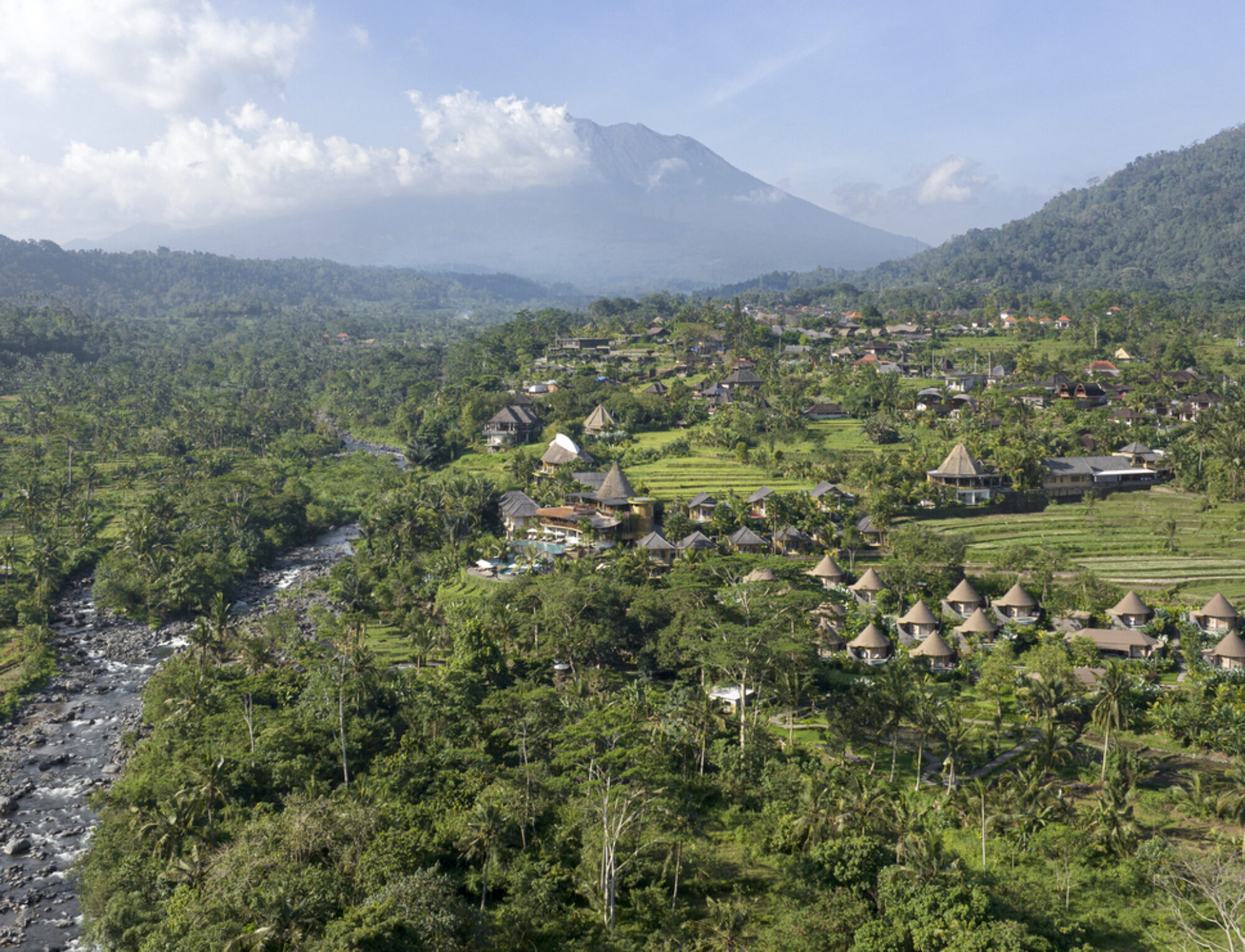
Four kms to the Northeast of Candidasa lies Bugbug, a sizeable rice-growing and fishing village. Along the way, the road climbs the unexpectedly steep Gumang Hill. There is beautiful panorama from the top of the sea, the Buhu river, rice fields and Bugbug, with the mountains of Lempuyang and Seraya in the distance. On a very clear day one can see Mt. Rinjani on Lombok from here.
Bugbug and the surrounding villages are quite old- fashioned. A part from the official village head, there is a council of elders responsible for all religious affairs. The elders are not elected, but enter the council on the basis of seniority. Another a typical feature of the villages is communal land tenure, and the presence of associations for unmarried boys and girls which have to fulfill duties in the context of village rituals.
TENGANAN VILLAGE
The ancient, ritualistic Bali Aga (‘Original Balinese’) society of Tenganan
Pegringsingan is microcosmic reflection of the macrocosm- an imago mundi. The village is laid out in a large rectangle measuring some 500 m by 250 m, encircled by natural boundaries and walls. Three public corridors rise in terrace- like fashion, running along a north- south axis from the sea toward the sacred volcano Gunung Agung. There are six lengthwise rows of compounds; the pairs located in the center and to the west are striking because of their closed house fronts, which resemble palm leaf covered longhouses.
Ritual clothing is an indispensable part of the sacred order of Tenganan
Pegringsingan. The double ikat cloths known as geringsing produced here rank among the master works of traditional textile art, providing a further sign of the divinely- ordained exclusivity of the society.
The cloths are said to have been directly inspired by Batara Indra, the Creator, who was once sitting in a tree enjoying the beauty of the moon and stars. While contemplating the heavens, he decided to teach the women of Tenganan the art of ikat patterning. Since then, the community has obeyed a divine commandment to wear kamben geringsing or double ikat cloths. In this way, the villagers evince purity and the ability to perform rituals- qualities which these clothes protect from harmful outside influences.
Among the most important religious duties of the villagers of Tenganan is the festive reception of gods and ancestors, where it falls during the fifth month of the Tenganan year, Sasih Sambah. The ceremonies that take place then are reminiscent of old Vedic swinging rites performed during the mahavrata winter solstice celebration as well as the Perang pandan ritual battle
AMLAPURA AREA
The main attraction of Amlapura is its traditional palaces or puri. There is a western, a northern, a southern and an eastern puri as well as several others- all still occupied by members of the royal family. Of these, only the Puri Kangin (the Eastern palace) on the main road to the market is easily visited. This is worth a look, as it gives a vivid impression of how local royals used to live. There is also a tale concerning the dynasty’s divine origin. A woman who lived near the palace was once overheard talking to a stranger in her house. When asked who it was, she replied that is was the god of Mt Agung. After some time, the woman become pregnant, and not long afterwards a miraculous fire descended from the mountain to the woman’s house. She soon gave birth to a son atop a hill to the east of the town- this son, the god of the eastern hill is said to be the founder of the royal Karangasem line.
Apart from being a man well- versed in letters, the last king of Karangasem, Anak Agung Anglurah Ketut, was also an assiduous builder of opulent pleasure palaces for his frequent excursions to the countryside with his wives and children. In fact, during his lifetime he built no less than three different water palaces- At Ujung, Tirtagangga and Jungutan respectively.
Ujung, 8 km to the South of Amplapura, is a small fishing village with distinct Islamic and Hindu- Balinese quarters. The lavish palace complex here- a vast pool bordered by small pavilions with a massive stained- glass and stucco bungalow in the center- was completely destroyed by the eruption of Mt Agung and subsequent earthquakes. Little else but a few sculptures and portals remain, though local authority is now has been restored the palace to its original condition as a tourist attraction. Just before Ujung there is road to the left leading toward Bukit Kangin (eastern hill) where there is a panoramic view of the area and a temple dedicated to the founder of the royal dynasty.
AMPLAPURA AREA – CONTINUE
The cool, spring- feed pools of Tirtagangga which literally means ‘Ganges Water’ and refers to sacred river of the Hindus- are located some 15 km northwest of Amplapura along the main road toward Singaraja. A dip in the pools is deliciously refreshing after a long drive, and they are surrounded by a captivating landscape of terraced rice fields. The village itself is small and quiet, and is a good place to pause and rest for several hours or even several days- to take advantage of the many delightful walks from here. From here there are a number of excellent treks through the surrounding countryside. One of the most spectacular begins to the north in the village of Tanah Aron, quite high on the slopes of Mt Agung.
The several neighboring villages of Subagan, Jasi, Bungaya, Asak and Timbrah just to the west of Amplapura are all very traditionalresembling the archaic Bali Aga village of Tenganan in many ways. Like Tenganan, Asak for instance is a caste- less village.
Bungaya on the hand, has groups of Brahmana but they do not take part in village rituals.
BESAKIH TEMPLE
Besakih Temple, known as Bali’s ‘Mother Temple’ for over 1,000 years, sits 1,000 metres high on the southwestern slopes of Mount Agung. Besakih is an artistic and unique complex that comprises at least 86 temples which include the main Pura Penataran Agung (the Great Temple of State) and 18 others. Besakih is the biggest and holiest of the island’s temples and is surrounded by breathtaking and scenic rice paddies, hills, mountains, streams, and more.
To the Balinese, visiting the temple sanctuaries is a special pilgrimage. Mount Agung’s high location gives it an almost mystical quality. Many stairs lead up to the sacred mountain, leading to the many temples that vary according to types, status, and functions.
Pura Besakih features three temples dedicated to the Hindu trinity. Pura Penataran Agung in the centre has white banners for Shiva, the destroyer; Pura Kiduling Kreteg on the right side is with red banners for Brahma, the creator; and Pura Batu Madeg represents Vishnu, the preserver, with its black banners. You can visit other temples in Pura Besakih, but many of their inner courtyards are closed to the public as they’re reserved for pilgrims.
Pura Besakih is the only temple open to every devotee from any caste groups. This is because of its nature as the primal centre of all ceremonial activities.
History of Besakih Temple; Pura Batu Madeg, containing a central stone, indicates that the area of Pura Besakih was already regarded a holy place since ancient times. In the 8th century, a Hindustani monk had revelations to build homes for people during his isolation. Throughout the process, many of his followers died due to illness and accidents.
On its completion it was called ‘Basuki’, referring to the dragon deity ‘Naga Besukian’, believed to inhabit Mount Agung. The name eventually evolved into ‘Besakih’.
Other shrines were gradually built and Pura Besakih was made the main temple during the conquering of Bali by the Majapahit Empire in 1343. Since then, Pura Besakih has had several restorations as earthquakes in 1917 and Mount Agung’s series of eruptions in 1963 damaged the complex. The lava flow passed by Pura Besakih and it is believed to be a miraculous signal from the deities that they wanted to demonstrate their power without completely destroying the holy complex their devotees had built for them.
Besakih Temple Highlights and Features The largest temple in the complex, Pura Penataran Agung, has different areas representing seven layers of the universe, each with their own shrines. Pura Pasimpangan on the downstream side (on the east of the main street) and Pura Pangubengan upstream are approximately three kilometres apart. Located on higher ground, the closest to Mount Agung’s peak, Pura Pangubengan has great vistas and it’s about a 30-minute walk from the main Pura Penataran Agung. Around 10 minutes to the east of Pura Pangubengan is Pura Batu Tirtha. It is where holy water is sourced for the ‘karya agung’ ceremonies at Pura Besakih and Pekraman villages. Four temples in the complex reflect four forms of God at compass points: Pura Batu Madeg in the north, Pura Kiduling Kreteg to the south, Pura Gelap in the east, and Pura Ulun Kulkul in the west. ‘Batu ngadeg’, literally ‘standing stone’, is found in the shrine of Meru Tumpang Sebelas at Pura Batu Madeg.
LEMPUYANG TEMPLE
A walk due east from Tirtagangga through the rice fields brings you to Pura Lempuyang, one of the Sad Kahyangan or six main temples of the whole of Bali, perched at the summit of Mt. Lempuyang (1058 m).
Lempuyang Temple, locally referred to as Pura Lempuyang Luhur, is one of Bali’s oldest and most highly regarded temples, on par with Besakih (aka the ‘mother temple’ of Bali). It is also believed to predate the majority of Hindu temples on the island.
Definitely a highlight on any travel itinerary for the fit and adventurous, the main temple lies at 1,175m above sea level, up on the peak of the namesake Mount Lempuyang in East Bali. The heights are reachable via a steep staircase of over 1,700 steps, with attractions along the way including several other temples and hordes of grey long-tailed macaques that inhabit the surrounding cool mountain forests.
While avid hikers will love the blend of mountains and cultural excursions that Bali’s eastern region has to offer, those unwilling to take on the ascent up to the peak at Lempuyang Temple can still enjoy the splendid views at the grand Pura Penataran Agung temple at the foot of the mountain. The first to come into view on the pilgrimage, this temple offers an impressive sight with its towering dragon staircases – perfect for photos. The best views are higher up the stairs, where you can see all the way across the green forested slopes and neighbouring Mount Agung, Bali’s highest peak and abode of Besakih Temple.
The locals strongly believe that besides maintaining respectful behaviour and speech, you shouldn’t complain on your way up – otherwise, you’ll never succeed reaching the main temple at the peak.